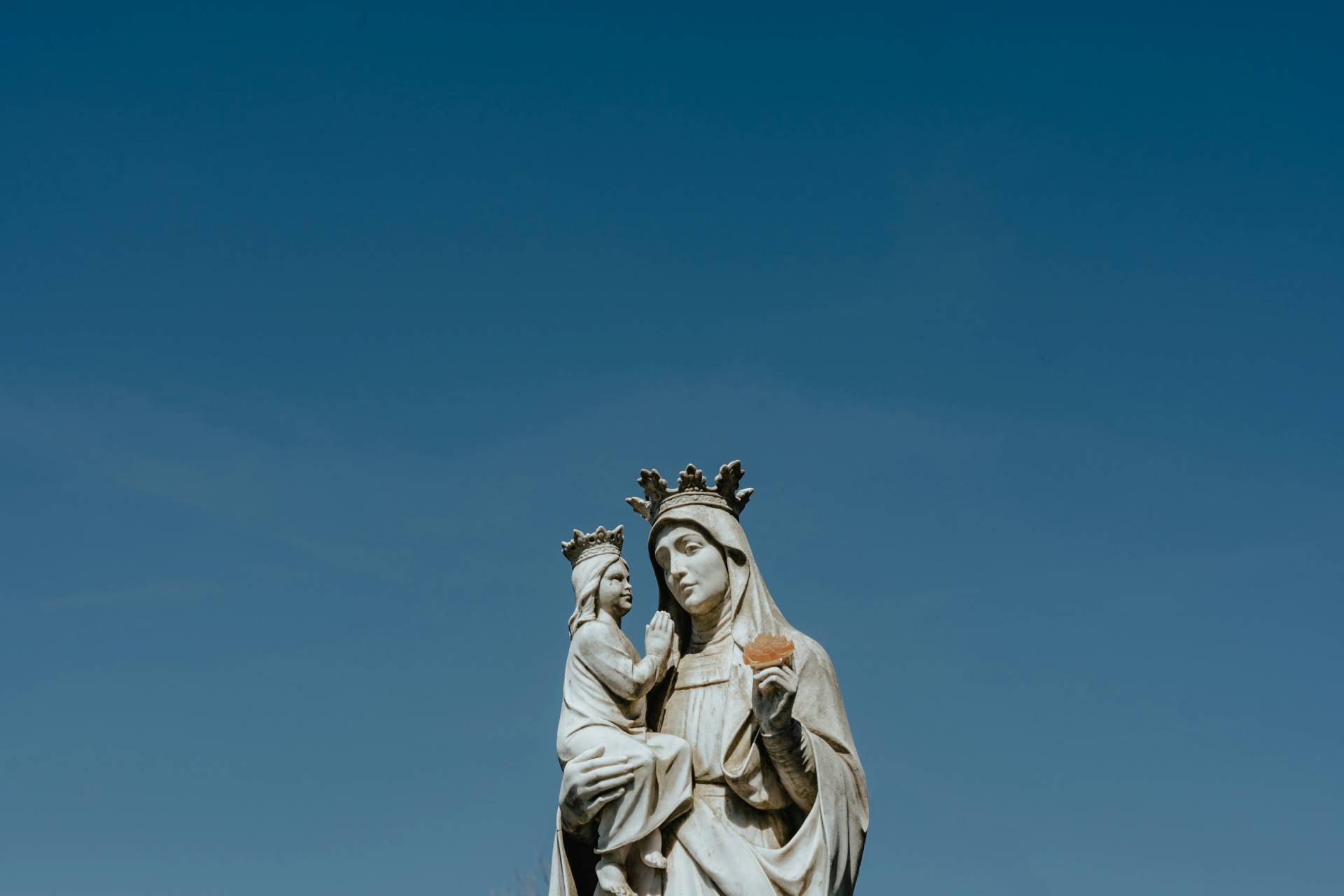
"Hail, full of grace, the Lord is with you." — Luke 1:28
When most people recite the Hail Mary, they think of a prayer — a familiar devotion repeated in Rosaries, Masses, and quiet moments of petition. But the Hail Mary is not merely a prayer. It is a royal proclamation, a heavenly greeting, and a theological declaration packed into thirty-five words.
To understand the Hail Mary is to encounter the Annunciation afresh — to stand in that room in Nazareth with the Archangel Gabriel and hear what Heaven actually said to Mary, and why it matters for every Catholic today.
"Hail" — A Word Reserved for Royalty
The prayer opens with a single word that modern readers easily pass over: Hail.
To contemporary ears, "Hail" sounds like an elevated "hello" — formal, perhaps poetic, but essentially a greeting. In the original Greek of Luke's Gospel, however, the word is chaire (χαῖρε), and it carried far more weight than any casual salutation.
In the Greco-Roman world, chaire was the greeting reserved for kings, emperors, and persons of the highest honor. It was the language of the royal court — the kind of word a subject speaks before a sovereign, not the kind of word a messenger uses to address a young girl in an obscure town in Galilee.
Yet that is precisely what Gabriel does. He opens his divine announcement not with a name, not with a command, but with a royal salutation.
This is not an accident of translation. It is a deliberate theological signal from the first word of the annunciation: the one being addressed holds a position of honor in the Kingdom of God.
Notice also what Gabriel does not say. In virtually every other angelic appearance in Scripture, the messenger begins with a phrase like "Do not be afraid." When Gabriel appeared to Zechariah (Luke 1:13), he opened with reassurance. When the angel appeared to the shepherds at Bethlehem (Luke 2:10), the first words were comfort against fear. But to Mary, Gabriel first gives honor. The word of royal greeting comes before the word of comfort — and only afterward does he add, "Do not be afraid."
This reversal is intentional. Gabriel is not merely informing Mary of a change in plans. He is announcing the inauguration of the Messianic Kingdom. And he addresses its Queen accordingly.
"Full of Grace" — The Word That Changed Everything
The second element of Gabriel's greeting is perhaps the most theologically rich phrase in the entire New Testament: kecharitōmenē (κεχαριτωμένη).
This word — often translated simply as "full of grace" or "highly favored one" — appears nowhere else in the Bible. It is unique to this moment, this person, this annunciation. And its Greek construction carries a precision that most English translations fail to convey.
Kecharitōmenē is a perfect passive participle of the verb charitóō, which derives from charis — the Greek word for grace, gift, and divine favor. In Greek grammar, the perfect tense describes a completed action whose effects continue in the present. The passive voice indicates that Mary is the recipient, not the source, of this grace.
Taken together, kecharitōmenē means something like this:
"You who have been completely and perfectly graced in the past, and who remain in that state of fullness now."
This is not a passing compliment. It is not a temporary commendation. It describes Mary's permanent identity — a soul that has been transformed by divine grace and continues, at this very moment, to dwell in the fullness of that transformation. The grace Gabriel sees in her is not borrowed for the occasion. It is constitutive of who she is.
Gabriel Uses Her Title, Not Her Name
Consider one more remarkable detail: Gabriel does not greet her by name. He does not say, "Hail, Mary." He says kecharitōmenē — as if that word is her truest name, her identity before God, her title in Heaven's court.
In ancient royal protocol, monarchs were addressed by their titles rather than their given names. A king might be addressed as "Your Majesty" or "O King" before his personal name was ever spoken. So too here: Mary's name in the presence of God is not "Mary of Nazareth." It is Kecharitōmenē — the Graced One, the Full-of-Grace One, the one whose entire being has been saturated with the life of God.
St. Jerome captured this in his Latin translation of the Scriptures — the Vulgate — rendering kecharitōmenē as gratia plena: "full of grace." This is the phrase that entered the Hail Mary prayer, and it is not decorative language. It is the most precise theological term available.
What the Church Fathers Saw
The early Church Fathers recognized in kecharitōmenē a scriptural foundation for what Catholic doctrine would later define as the Immaculate Conception — the teaching that Mary was preserved from original sin from the very first moment of her existence, filled with sanctifying grace in preparation for her role as the Mother of God.
The logic flows directly from Gabriel's words: if Mary is kecharitōmenē — completely graced, permanently transformed — then this grace did not begin at the Annunciation. A soul saturated with the fullness of divine life could not also have been, at some prior moment, subject to the privation of original sin. The grace described by Gabriel is not a response to sin; it is the absence of it.
To pray "Hail Mary, full of grace" is to echo the angel's proclamation and to affirm what the Church has always believed: that Mary's holiness is not an afterthought but a divine preparation.
The Queen Mother in the Kingdom of God
Gabriel's royal greeting makes full theological sense when understood against the background of the Old Testament — specifically, the structure of the Davidic kingdom.
In ancient Israel, the king's mother held a unique and formal office. She was known as the Gebirah — the "Great Lady" — and she was enthroned at the king's right hand as the Queen Mother. This was not a ceremonial title. In the Davidic monarchy, it was the king's mother, not his wife, who bore the official queenly role. When Solomon was crowned, his mother Bathsheba sat at his right hand (1 Kings 2:19), and when she came to make a request of the king, Solomon rose to meet her, bowed, and seated her beside him.
Gabriel tells Mary in Luke 1:32–33 that her Son will be given "the throne of his father David," that "he will reign over the house of Jacob forever," and that "his kingdom will have no end." These words are not general praise — they are a formal declaration that Jesus is the Davidic Messiah, the King whose reign is eternal.
If Jesus is the eternal Davidic King, then by the established logic of the Davidic Kingdom, Mary is the Queen Mother — enthroned beside her Son in the heavenly court, her intercession carrying the weight of a mother's love and a queen's authority.
This is why Catholics honor Mary as the Queen of Heaven — not because she is divine, for she is not, but because she has been elevated by God's grace to the highest position a creature can hold: Mother of the King of Kings. Her queenship is entirely derivative and entirely real. It is given to her by God, displayed before her by Gabriel's greeting, and acknowledged by the Church in the words of the Hail Mary.
Every Hail Mary Is a Royal Salute
When the faithful recite the Hail Mary, they are doing something far more profound than repeating a formula.
They are joining the Archangel Gabriel in his royal salutation. They are echoing Elizabeth, who cried out in the Holy Spirit: "Blessed are you among women, and blessed is the fruit of your womb!" (Luke 1:42). They are affirming what Heaven proclaimed at the Annunciation: that Mary is not an ordinary woman but the Graced One, the Queen Mother, the Immaculate Vessel through whom the Word of God entered the world.
When the prayer continues — "Holy Mary, Mother of God, pray for us sinners, now and at the hour of our death" — it is not an appeal to a distant historical figure. It is a petition to a royal intercessor, a Queen enthroned beside the King, whose prayers He receives with a Son's love. Her tenderness is not separate from her authority; it is clothed in it.
To say "Hail Mary" is to kneel, spiritually, before the one Heaven first knelt before. It is to lift our eyes toward the Queen of Mercy and to trust that her intercession reaches the heart of Christ — because a mother's voice always does.
A Prayer Worth Praying Slowly
The Hail Mary takes less than thirty seconds to recite. But behind those thirty-five words lies the whole theology of the Annunciation: a royal greeting, an angelic title of unique grace, the fulfillment of the Davidic covenant, the Immaculate preparation of the God-bearer, and the intercession of a Queen who has never stopped caring for her children.
The next time you pray it, let the words land with their full weight.
Hail — the royal salute of an archangel, addressed to a Queen. Full of grace — the permanent identity of the one transformed by God from the first moment of her existence. The Lord is with you — the announcement that the Eternal Son is about to dwell within her. Blessed are you among women — the confirmation of a heavenly declaration, spoken by a woman filled with the Holy Spirit. Holy Mary, Mother of God — the title that contains everything: her holiness, her divine maternity, her queenly dignity. Pray for us sinners — the humble petition of children to their mother, who reigns beside her Son and never stops interceding.
The Hail Mary is not a repetition. It is a proclamation — and every time we pray it, we join our voices to the eternal court of Heaven.
May the Lord bless you and keep you.