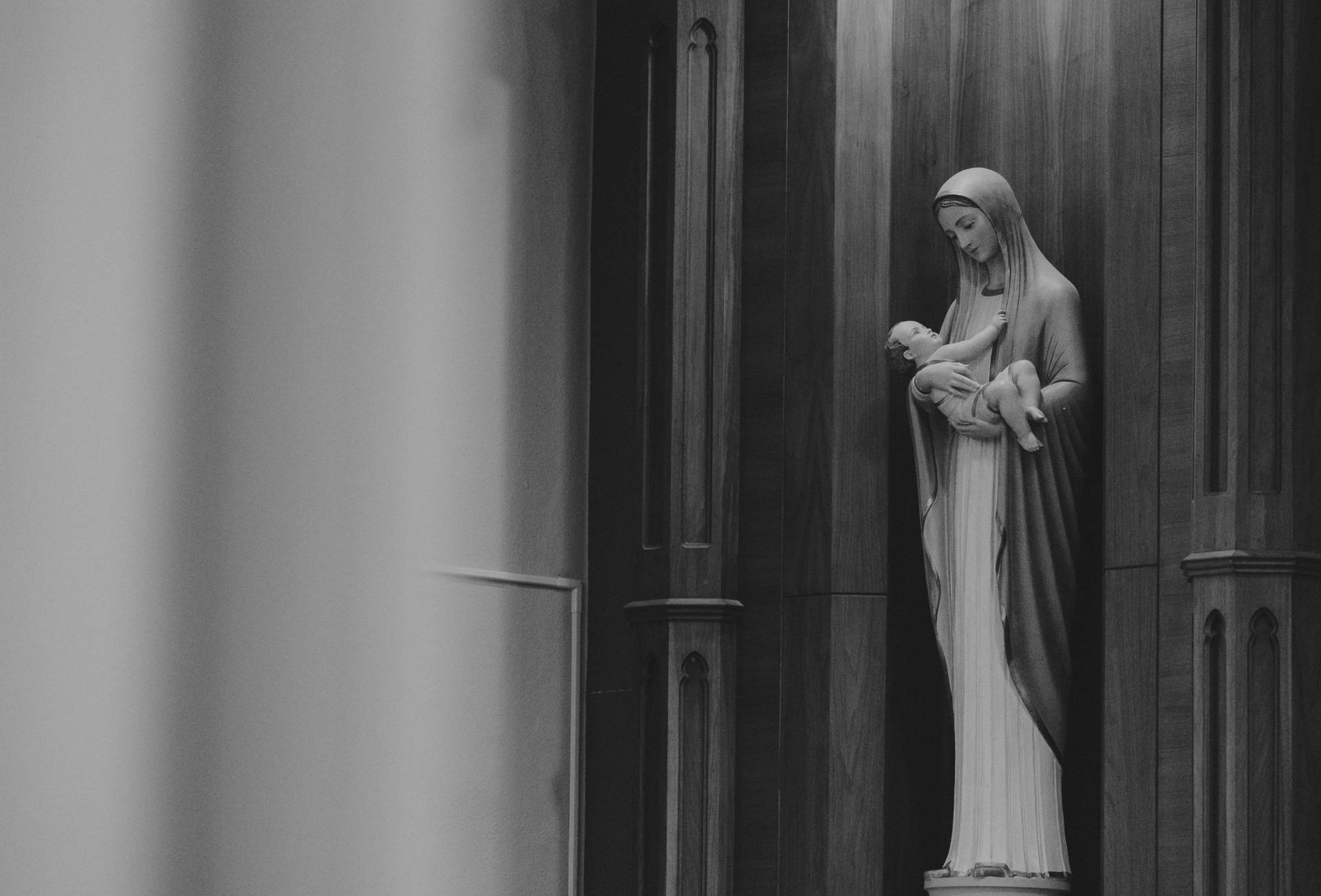
"Hail, full of grace, the Lord is with you." — Luke 1:28
Most people who have prayed the Hail Mary their entire lives read the third part of Gabriel's greeting as a warm reassurance. A divine encouragement. God is on your side, Mary. You are a holy woman. You walk faithfully with him. He has your back.
It is one of the most significant misreadings in all of Scripture.
Because Gabriel is not offering Mary encouragement. He is not complimenting her prayer life. He is not telling her that God is rooting for her. He is making a statement of ontological fact — describing a reality that exists in her at the level of being itself, completing a thought he already began with kecharitōmenē, and in doing so, quietly announcing that something has happened in human history that has not happened since the Garden of Eden.
One Statement, Said Twice
To understand what Gabriel means by "the Lord is with you," you have to read it in direct continuity with everything that came before it in the same breath.
Kecharitōmenē — she is the graced one. Not a woman who has grace as one of her qualities. A woman whose very being is constituted by God's own grace, his own life filling her so completely that there is no separation, no sin, no distance between her soul and its Creator. Grace is not something she carries. It is what she is, at the level of existence itself.
And then, immediately, completing the same thought: ho Kyrios meta sou — the Lord is with you.
These are not two separate statements joined by coincidence. They are one statement said twice, from two different angles, describing the same reality.
The first — kecharitōmenē — describes it from the inside. From the perspective of what Mary is in her soul, in her nature, in the mode of her being. She is filled with God's own life so completely that nothing separates her from him.
The second — the Lord is with you — describes the same reality from the outside. From the perspective of what that means in terms of God's actual presence. When a soul is so completely filled with God's own grace that sin is entirely absent, God is not merely near. He is not merely favorable. He is there. Dwelling. Present. With.
Kecharitōmenē and the Lord is with you are synonyms. They are two ways of naming the same state — the state of a human soul in complete, permanent, uninterrupted reconciliation with God, filled with nothing but his own life, separated from him by nothing at all.
Gabriel is not making two points. He is making one point, with the precision of a theologian and the authority of Heaven, stated twice so that nothing is lost.
What Was Lost at the Fall
To feel the full weight of what Gabriel is saying, you have to go back to the beginning.
Before the Fall, Eden was not merely a garden. It was the place where God walked with his people — where his presence dwelt among them not in shadow, not in symbol, not through an intermediary, but directly, personally, actually. Adam and Eve existed in a state of unbroken communion with God. His own life filled them. His own grace constituted their existence. There was no separation, no distance, no incompatibility between the creature and the Creator.
And then sin entered. And with sin, separation. God's presence — which had been the very atmosphere of human existence — withdrew. Not arbitrarily, not as punishment imposed from outside, but because sin and God's presence are ontologically incompatible. Where one is, the other cannot fully dwell. Light and darkness do not coexist. Remove the light and what remains is not the light's absence as a neutral fact — it is darkness, actively, really, as the condition of the space the light once filled.
After the Fall, God did not abandon his people. But the direct, unmediated, walking-together presence of Eden was gone. And the entire Old Testament is the story of God reaching back toward his people — working, through covenant and law and prophecy and sacrifice, to restore what the Fall had ruptured.
The tabernacle in the desert — God's presence dwelling among his people in a tent, approached only by priests, only through elaborate ritual, separated from the people by curtains and consecration. A real presence, but mediated. Partial. Shadowed.
The temple in Jerusalem — God's glory filling the Holy of Holies, the place so sacred that the High Priest entered only once a year, with bells on his robe so the people could hear whether he was still alive inside. A real presence, but contained. Bounded. Approached with fear.
The Ark of the Covenant — the physical vessel of God's presence, built to his exact specifications, carried on poles so human hands would not touch it directly, striking dead those who approached it improperly. A real presence, but enclosed. Requiring a vessel of precise and consecrated holiness to contain it.
All of it — the tabernacle, the temple, the ark, the cloud and fire in the desert, the pillar of smoke by day — every one of these is God reaching toward his people, drawing near, dwelling among them in whatever partial and shadowed way the condition of fallen humanity could bear. Every one of them is a promise that what was lost in Eden has not been abandoned. Every one of them is pointing forward, toward a restoration that has not yet come.
And then Gabriel stands before a young woman in Nazareth and says eight words.
"Hail, full of grace, the Lord is with you."
The Lord Is With You — Actually, Ontologically, Fully
Not in a tent. Not behind a curtain. Not in a box of gold carried on poles. Not in a temple of stone that will one day be destroyed.
In her.
In a human being. In flesh. In a creature of history and time and blood, standing in a room in first-century Galilee. God's own presence — the same presence that filled Eden, that the tabernacle and the temple and the ark were all reaching toward, that the entire Old Testament was promising and foreshadowing — dwelling in her. Not as a symbol. Not as a shadow. Not mediated through ritual or separated by curtains. Fully. Actually. Ontologically.
The Lord is with you.
This is not encouragement. This is the announcement that the long story of God reaching back toward his people has arrived, in this woman, at a new and unprecedented moment. Mary is the living fulfillment of every temple, every tabernacle, every ark that came before her. She is the place where God's presence dwells not in symbol but in reality, not partially but completely, not temporarily but as the permanent condition of her existence.
She is a walking Eden. The Garden restored in a person. The first human being since the Fall in whom God's presence dwells not in shadow and symbol but as the actual, unmediated, uninterrupted reality that Adam and Eve knew before sin entered the world.
And she was this before the Incarnation had even begun. Before Gabriel finished his sentence. Before Mary said yes. The Lord was already with her — because kecharitōmenē already defined her. Because God's own grace already constituted her being. Because she was already, from the first instant of her existence, the vessel in whom his presence could dwell fully and without the incompatibility that sin introduces.
With, and Then Within
And then comes the mystery that takes the breath away.
Gabriel has declared that the Lord is with Mary. Present. Dwelling. Ontologically there in the fullness that her kecharitōmenē state makes possible.
But the rest of his message reveals that this is not the destination — it is the preparation. Because the Lord who is already with her is about to become the Lord within her. The presence that already dwells in her by grace is about to dwell in her by flesh. The God who fills her soul is about to fill her womb. The one who is already her God is about to become her Son.
The movement from with to within is the movement of the entire Incarnation — and it is only possible because of everything Gabriel has already declared. You cannot move from with to within unless the vessel is already adequate to the presence. You cannot ask God to take flesh from a woman whose flesh is incompatible with his holiness. The with had to be complete before the within could begin.
Kecharitōmenē — she is the graced one, God's own life constituting her being. The Lord is with you — he dwells in her, fully, actually, without mediation or shadow. And now he is about to dwell in her as one of us.
Gabriel's greeting is not three separate thoughts. It is one seamless theological declaration moving in a single direction — from the nature of her being, to the presence of God within her, to the mission that her nature and his presence now make possible.
She is the walking Eden. The living ark. The new tabernacle. The restored temple. And she is about to become something more — the mother of the one who will make it possible for all of us to become, through him, what she already is.
"The virgin will conceive and give birth to a son, and they will call him Immanuel — which means, God with us." — Matthew 1:23
May the Lord bless you and keep you.