


























The Vessel and the Presence: Why the Immaculate Conception Is a Theological Necessity
The Immaculate Conception is already there, fully present, in the first word Gabriel spoke.
"Was it not necessary that the Christ should suffer these things and enter into his glory?" — Luke 24:26
The Immaculate Conception is often presented as a devotional tradition — a beautiful belief about Mary that Catholics hold with reverence, defined formally by Pope Pius IX in 1854, celebrated on the eighth of December. And it is all of those things.
But it is also something that tends to get lost in the way the doctrine is usually taught: it is a theological necessity. Not a pious addition to the faith. Not an elaboration beyond what Scripture requires. A logical consequence, arrived at by strict reasoning from principles that Scripture itself establishes — principles about the nature of God, the nature of holiness, and the conditions under which God's presence can dwell in anything at all.
The argument does not begin with Mary. It begins with God.
The Principle Scripture Never Breaks
God cannot dwell in what is not holy.
This is stated throughout Scripture in a hundred ways, but it is never contradicted once. It is not an arbitrary rule that God imposes from outside — it is a statement about what God himself is, and therefore about what his presence requires of anything that would contain it.
God is holiness itself. His being is incompatible with sin not because he chooses to be offended by it, but because sin is the privation of his life — the absence of the very thing he is. Where his life is fully present, sin cannot be. Where sin is, his life cannot fully dwell. These are not two preferences in tension. They are two ontological states that cannot occupy the same space, the way light and darkness cannot coexist. Darkness is not a thing in itself — it is the absence of light. And where light fully dwells, darkness simply is not.
Scripture encodes this principle in three parallel structures, each more intimate than the last, each making the same point with increasing precision. Together they build an argument that arrives, with the force of logical necessity, at the Immaculate Conception.
The Ark: The Vessel Must Match the Presence
The Ark of the Covenant was not built to God's exact specifications as a matter of divine aesthetic preference. Every measurement, every material, every detail of its construction was prescribed by God because his presence was going to dwell within it — and for that presence to dwell, the vessel had to be exactly what he required.
The consequences of approaching the Ark improperly were immediate and total. When Uzzah reached out his hand to steady the Ark as it tipped on the cart, God struck him dead on the spot (2 Samuel 6:6-7). Not because Uzzah had malicious intent — he was trying to help. But because the holiness of what dwelt within the Ark made any improper contact with it lethal. The vessel demanded a corresponding holiness in everything that approached or touched it, because the presence dwelling within it was of infinite holiness and nothing less could be compatible with it.
The principle the Ark establishes is this: the holiness of the vessel must be adequate to the holiness of the presence it contains. The container must be commensurate with the contained. God does not lower his presence to fit an inadequate vessel — the vessel must be raised to meet his presence.
This is why the Ark was overlaid with pure gold. This is why it was carried on poles — so human hands would not touch it directly. This is why it was kept in the Holy of Holies, separated from the people by curtains, approached only by the High Priest, only on Yom Kippur, only with blood and incense and elaborate ritual preparation.
Every precaution surrounding the Ark was Scripture's way of encoding the principle: where God dwells, holiness is not optional. It is the condition of the dwelling.
The Eucharist: The Living Vessel Must Also Be Holy
The Ark established the principle with a physical object. The Eucharist applies it to the human person — and in doing so, makes the argument one step more intimate and one step more precise.
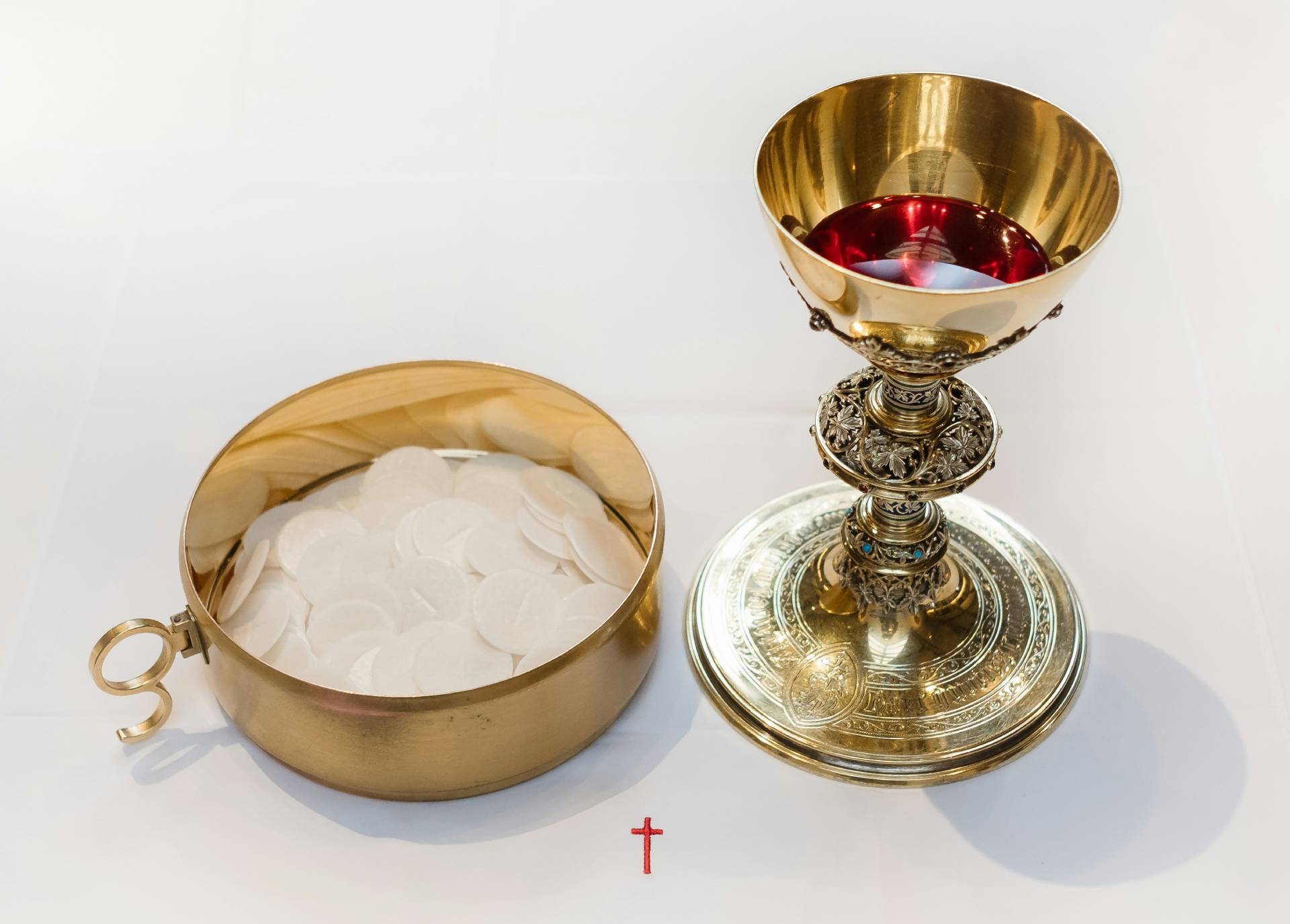
When we receive the Eucharist, we are not receiving a symbol of Christ's presence. We are receiving Christ himself — his body, blood, soul, and divinity, truly and substantially present under the appearances of bread and wine. The God who dwelt in the Ark, the God who filled the Holy of Holies, the God before whom the High Priest trembled once a year — that God is present in the Eucharist, and when we receive it worthily, he dwells within us.
We become, in that moment, living tabernacles. Living arks. The temple of God not made of wood and stone but of flesh and blood. Paul says it explicitly: "Do you not know that your body is a temple of the Holy Spirit within you?" (1 Corinthians 6:19).
But the same Paul who declares this also establishes the condition without which it cannot happen rightly. In 1 Corinthians 11:27-29, he warns that whoever eats the bread or drinks the cup of the Lord in an unworthy manner eats and drinks judgment upon themselves — because they have not discerned the body of the Lord. To receive God within you while in a state of mortal sin is not a neutral act. It is a collision between incompatible realities — the presence of God's own holiness and the presence of sin, which is the privation of that very holiness.
This is why the Church requires confession before Communion for those in mortal sin. Not as a bureaucratic obstacle. Not as a legalistic hurdle. As the sacramental expression of the same principle the Ark already established: the vessel must be made holy before it can contain God's presence. You cannot carry God within you while sin occupies you. The two states are incompatible by nature.
And yet — and this is where your own insight becomes theologically essential — even worthy Eucharistic reception does not bring us into the fullness of kecharitōmenē. When we receive the Eucharist in a state of grace, we enter what might be called a pre-kecharitōmenē: a real, genuine, deeply sacred foretaste of the state of complete reconciliation with God, but not yet its fullness. We still bear death. We still carry concupiscence — the inclination toward sin that remains even after it is forgiven. We still exist in fallen bodies subject to weakness, decay, and the slow work of mortality.
The Eucharist brings us into God's presence. But it does not yet bring us into the permanent, uninterrupted, fully constituted state of kecharitōmenē — the state in which God's own being fills us so completely that sin is not merely forgiven but entirely absent, not merely covered but constitutively impossible. That state awaits Heaven, awaits the resurrection of the body, awaits the moment when death itself is swallowed up in final victory.
What the Eucharist gives us is real and sacred and transformative — but it is the trajectory, not the destination. It is the child's inheritance in promise, not yet in fullness. The parent and child are truly one family, genuinely in relationship, really sharing the same life — but the child has not yet come into the full inheritance that awaits at the end.
The principle the Eucharist establishes is this: even for the partial, temporary, sacramental dwelling of God within a human person, sin must first be removed. The vessel must be prepared. The presence demands holiness from whatever contains it, even imperfectly and temporarily.
Mary: The Vessel of the Incarnation
Now apply both principles — the Ark and the Eucharist — to Mary. And apply them with full logical consistency, without flinching from where they lead.
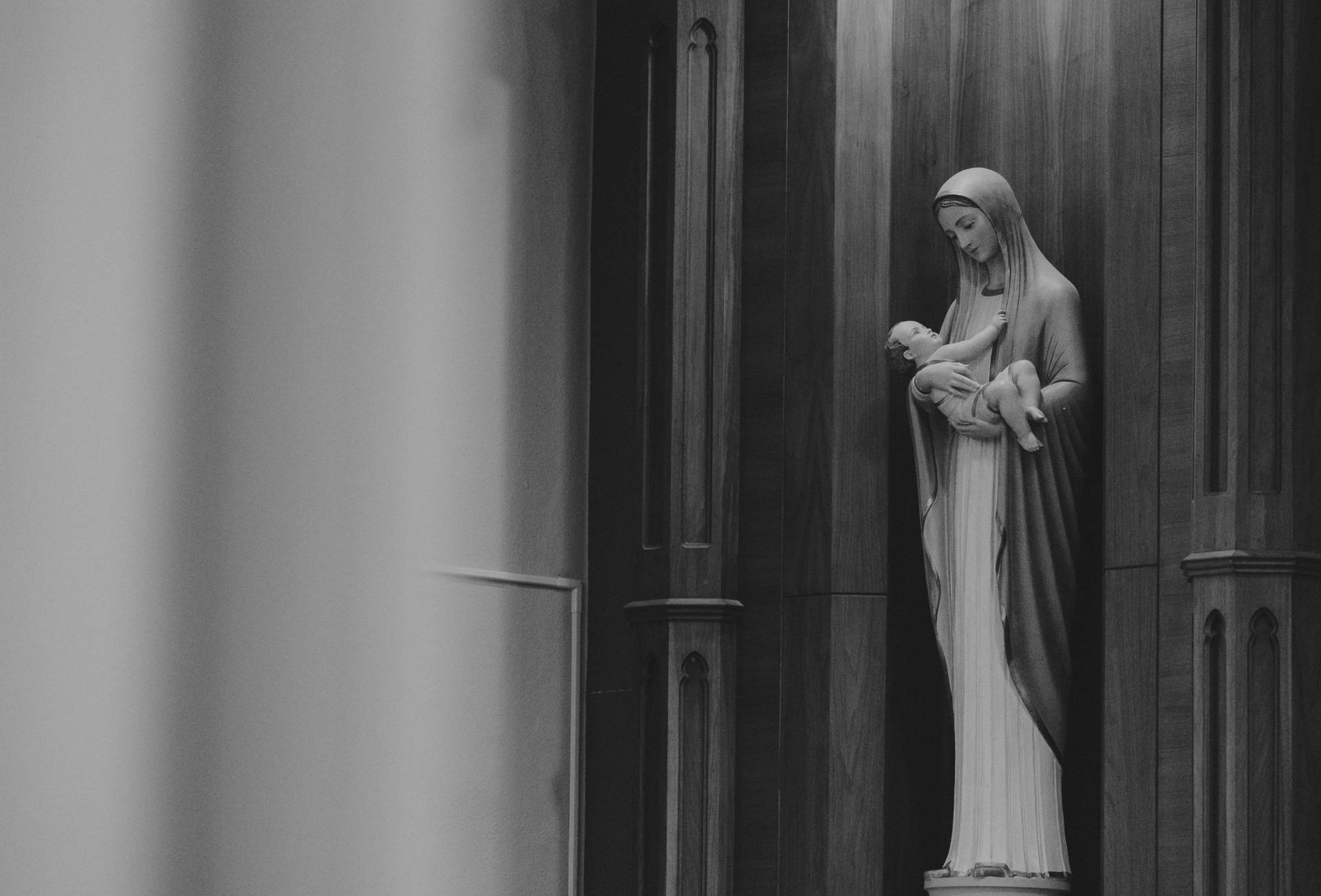
Mary was not asked to carry the Ark. She was not asked to receive the Eucharist. She was asked to carry God himself — not his presence dwelling in an object of gold, not his presence dwelling sacramentally under the appearances of bread and wine, but his presence as a human child, formed from her own flesh, nourished by her own blood, dwelling within her body for nine months in the most intimate physical union possible between two human beings.
The eternal Son of God took his human nature from her. His humanity — the humanity in which he would live, suffer, die, and rise — was constituted from her flesh. She did not merely house him the way a room houses a guest. She provided the very material of his human existence. He was of her, from her, through her, in the most radical biological and ontological sense.
If the Ark — a vessel of gold and wood — had to be built to God's exact specifications to carry his presence.
If we — human beings in a state of grace — still cannot enter the fullness of kecharitōmenē through the Eucharist, still bear death and concupiscence even as God dwells within us sacramentally.
Then what must the vessel be that carries not the symbol of God's presence, not the sacramental presence of God, but God himself, in person, in flesh, formed from her own body?
The answer follows from the premises with the force of logical necessity.
She must be kecharitōmenē. Not approaching it. Not restored to it by confession the week before. Not touching it temporarily in a moment of Eucharistic grace. She must simply, permanently, from the very first instant of her existence, be it — the state of complete, uninterrupted, constitutive holiness in which God's own life fills her so completely that sin is not merely absent but has never been present, not for a single instant, not in any degree.
Why Confession Is Not Enough
This is the point at which the argument becomes most precise — and most important.
Someone might object: could Mary not simply have been a sinner who was cleansed? Could God not have purified her at some point before the Incarnation — through a moment of extraordinary grace, through a kind of pre-emptive redemption — and then used her as the vessel of the Incarnation?
The answer is no. And the reason is not arbitrary. It follows directly from the principle that the Eucharist already established.
We confess our sins and receive the Eucharist worthily — and even then, even in that state of restored grace, we are still not in the fullness of kecharitōmenē. We still bear death. We still carry the wound of original sin even after its guilt is removed. We are in a state of real grace, genuine holiness, actual preparation — but we are not in the permanent, constitutive, uninterrupted state that kecharitōmenē names.
If even worthy Eucharistic reception — the most intimate union with God available to us in this life — does not bring us into the fullness of kecharitōmenē, then a prior cleansing followed by the Incarnation would not be sufficient either. A sinner who is cleansed is still not the same as a soul that was never touched by sin. The wound, even healed, leaves a different reality than a nature that was never wounded. The vessel, even purified, remains a different kind of vessel than one that was constituted holy from the beginning.
For Mary to carry God in the fullness of the Incarnation — formed from her flesh, dwelling within her body — she could not merely be a cleansed sinner. She had to be constituted holy. She had to be, from her very first moment of existence, kecharitōmenē — the graced one, the one in whom God's own life dwells so completely that there was never a moment, not a single instant, in which the incompatibility of sin and divine presence could even arise as a question.
The Immaculate Conception is not a pious elaboration. It is the only version of Mary that makes the Incarnation coherent. Any other version of Mary — a Mary who sinned and was cleansed, a Mary who was purified at some point before the Annunciation, a Mary who was holier than other humans but still marked by original sin — any of these fails the test that the Ark and the Eucharist together establish.
The holiness of the vessel must be adequate to the presence it contains. The Incarnation is the most intimate, most total, most complete dwelling of God within a creature in all of human history. Therefore the vessel of the Incarnation must be the most holy vessel in all of human history — not holy by preparation, not holy by restoration, but holy by constitution, by nature, from the beginning, without interruption, without exception.
Gabriel Knew
This is why Gabriel said what he said before he said anything else.
Before the mission. Before the explanation. Before even her name. The very first substantive word out of his mouth was kecharitōmenē.
He was not greeting her. He was not complimenting her. He was declaring the theological precondition of everything that was about to happen — announcing to her, and to history, and to us, that the vessel is already adequate to the presence it is about to receive.
You cannot carry God unless you are kecharitōmenē. Mary is kecharitōmenē. Therefore Mary can carry God.
The Immaculate Conception is already there, fully present, in the first word Gabriel spoke. The Church did not invent it in 1854. She recognized in 1854 what Gabriel had already declared in Nazareth two thousand years before — and what the logic of the Ark, the Eucharist, and the nature of God had been pointing toward throughout the entire history of salvation.
Eight words. One greeting. The entire doctrine, encoded and waiting, in the first sentence an angel ever spoke to the Mother of God.
"Do you not know that your body is a temple of the Holy Spirit within you, whom you have from God?" — 1 Corinthians 6:19
May the Lord bless you and keep you.

About the author
I'm a Catholic layman from Fort Lauderdale, Florida. No seminary, no credentials — just a deep love for the Faith and a conviction that ordinary Catholics are called to evangelize.
Related articles
Apologetics
The Perpetual Virginity of Mary: A Complete Linguistic, Historical, and Theological Defense
The perpetual virginity of Mary — the teaching that Mary remained a virgin before, during, and after the birth of Jesus — is one of the oldest and most consistently held beliefs in Catholic and Orthodox Christianity.

Join the community
Subscribe to our weekly newsletter for curated inspiration, delivered to your inbox.
We never share your data. See Privacy Policy for more info.