





























What Gabriel Actually Called Mary: The Deepest Meaning of "Full of Grace"
Gabriel wasn't offering a greeting in any conventional sense. He was making a statement about the nature of Mary's very existence
"Hail, full of grace, the Lord is with you." — Luke 1:28
Most Catholics have prayed the Hail Mary thousands of times. But very few have stopped long enough to ask what Gabriel was actually saying — grammatically, philosophically, and theologically — when he opened his mouth in that room in Nazareth.
Because if you look carefully at the Greek, you find that Gabriel wasn't offering a greeting in any conventional sense. He was making a statement about the nature of Mary's very existence. And understanding what he said changes how you understand not only Mary, but grace itself.
The Word That Has No Parallel
The Greek word at the center of Gabriel's greeting is kecharitōmenē (κεχαριτωμένη). It appears nowhere else in the entire New Testament. It is unique to this moment, this person, this annunciation.
Most English translations render it as "full of grace" (following St. Jerome's Latin gratia plena) or "highly favored one" (a flatter Protestant rendering that, as we'll see, misses the deeper point). But neither phrase fully captures what Gabriel actually said, because the question isn't just what the word means — it's what grammatical function it serves in the sentence.
Here is the key: kecharitōmenē is not functioning as an adjective in Gabriel's greeting. It is functioning as a noun. It is not describing Mary. It is identifying her.
Gabriel doesn't say "Hail, Mary, who is full of grace." He says Kecharitōmenē — and that word alone stands where her name would normally go. He doesn't use her name at all. The graced one. That is what he calls her. That is who she is to Heaven.
Has vs. Is — The Most Important Distinction
This is where the theology becomes philosophically precise, and it's worth slowing down for.
There is a fundamental difference between saying someone has a quality and saying someone is a quality. When we say a person has courage, we mean courage is one of their attributes — something they possess alongside other attributes, something that could theoretically be separated from them without ceasing to be them. But when we say fire is hot, we are not describing a property fire happens to carry. We are describing what fire is at the level of its very nature. Heat is not added to fire. It is constitutive of fire. Remove it and you no longer have fire.
Kecharitōmenē puts Mary in the second category, not the first.
Gabriel is not saying Mary possesses grace as one of several qualities she carries. He is saying that grace, in Mary's case, has become constitutive of her being. It is what she is, not what she has. The distinction is ontological — it goes to the level of existence itself.
In scholastic terms, this is the difference between habere and esse — between having and being. Most souls who receive grace have it, as a gift received, something added to their nature from outside. For Mary, grace is not an addition. It is the very mode of her existence as a creature. She does not carry grace. She is the graced one — at the level of esse, of being itself.
This is why kecharitōmenē functions as a name in Gabriel's mouth, not a compliment. Names don't describe qualities a person happens to have at a given moment. Names declare what something fundamentally is.
Why the Renaming Analogy Breaks Down
It is tempting to reach for the biblical pattern of divine renaming to explain what Gabriel is doing — to say that he is doing for Mary what God did for Abram when he became Abraham, or for Simon when Christ named him Peter.
But that analogy, however useful it seems at first, actually leads in the wrong direction. And seeing why it fails reveals something essential about Mary.
When God renamed Abram, he was marking a transition. There was a before and an after. Abram became Abraham because God called him into a covenant that hadn't existed before. Something changed. The new name declared the new reality — a reality that came into being at a specific moment in time.
When Christ renamed Simon as Peter, he was doing the same thing — declaring what Simon would become through the grace of discipleship. Again, a transition. A before and an after. The name marks the turn.
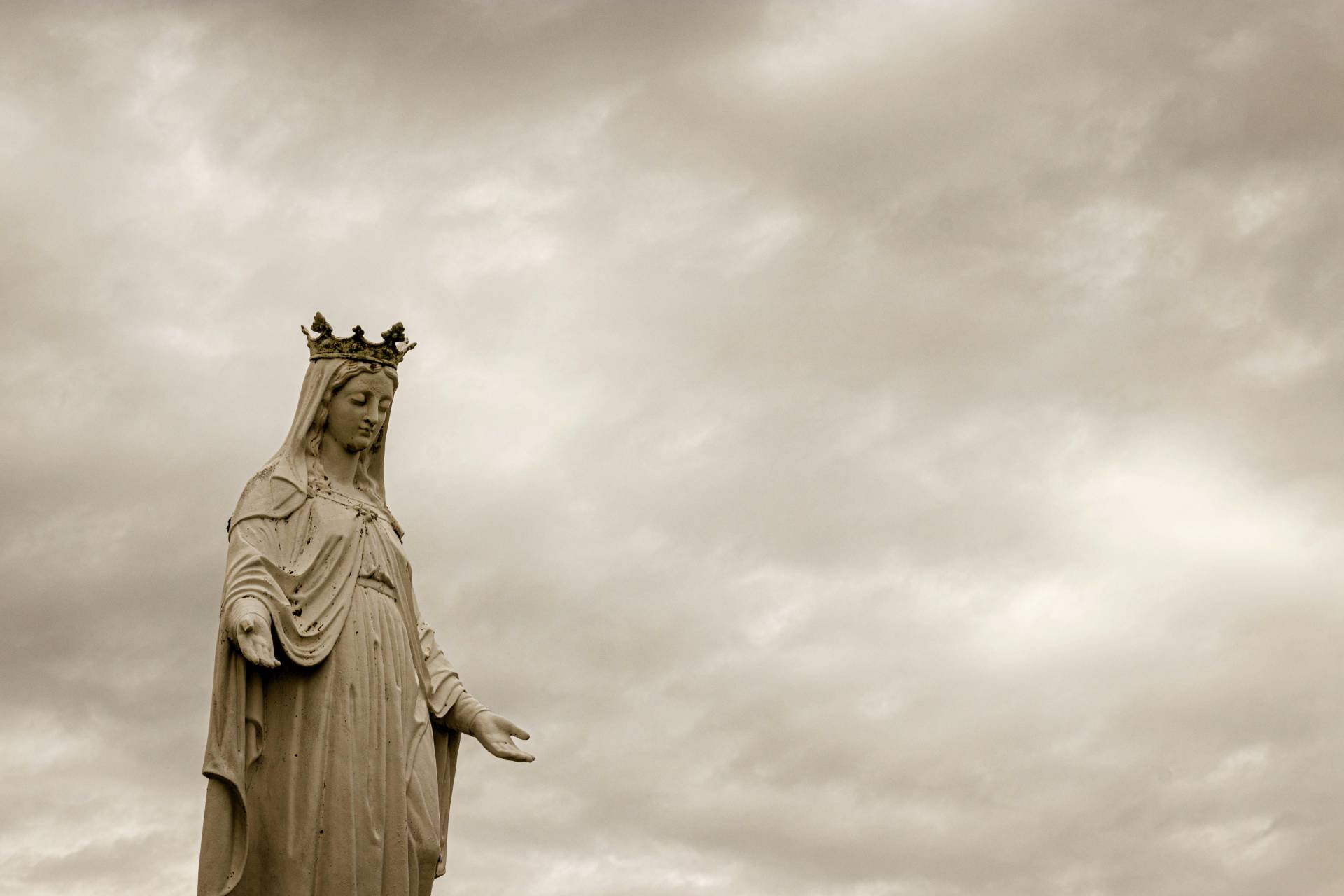
But Mary has no before and after of that kind. The Immaculate Conception — the Church's dogmatic teaching that Mary was preserved from original sin from the very first instant of her existence — means there was no prior state of sinfulness out of which she was transformed. There was no moment in her life when grace arrived and changed her. She was not redeemed in the way that implies a fall and a rescue. She was preserved. She has been kecharitōmenē from the first moment she existed.
So Gabriel is not renaming her. He is not declaring a transformation. He is not marking a before and after. He is revealing what has always been true — speaking aloud the name she has always had before God, the name that was hers before she drew her first breath, the name God gave her in eternity before time touched her.
This is closer to what God says to Jeremiah: "Before I formed you in the womb I knew you, before you were born I set you apart." (Jeremiah 1:5) Not a change — a disclosure. The calling pre-existed the person's awareness of it. Gabriel is unveiling an eternal identity, not conferring a new one.
And this is precisely what the perfect tense of kecharitōmenē is communicating. In Greek, the perfect tense describes a completed action whose effects continue permanently in the present. The grace it describes is not recent. It is not the result of something that happened at the Annunciation. It points to a state of being that has no temporal origin we can name — because God established it before time itself reached her.
The Name Heaven Always Called Her
Bring this together and something remarkable emerges.
Kecharitōmenē is not a description of something Mary received. It is the disclosure of what she permanently, essentially, and irreversibly is — not as an achievement, not as a reward, but as an eternal divine intention for her existence expressed in the mode of her very being.
When Gabriel speaks this word, he is not giving Mary a new identity. He is speaking, for the first time in human history, the name that God has always called her — the name that existed before she was conceived, the name written into her nature at the moment of her creation, the name that will be hers for eternity.
She is not grace personified. She is a creature — fully human, entirely dependent on God for everything she is. But she is the creature in whom grace has achieved what it was always meant to achieve in a human soul — completely, permanently, without interruption, from the very first moment of her being.
She is the graced one. Not because grace was added to her. But because grace is constitutive of what she is. Because God, in his eternal freedom, willed that one creature would enter existence already dwelling in the fullness of his life — and that creature would be the one through whom his Son would enter the world.
What This Means When We Pray
Every time the faithful pray the Hail Mary, they open with Gabriel's word — and now perhaps it can land differently.
"Full of grace" is not a poetic flourish. It is not a compliment. It is an ontological declaration — a statement about what Mary is at the level of being. And when we address her with those words, we are acknowledging something that Heaven acknowledged before history began: that she is the one creature whose entire existence is constituted by the grace of God, the one whose name in eternity is simply the graced one.
To say "Hail Mary, full of grace" is to echo Gabriel — not with a greeting, but with a recognition. We are naming her the way Heaven named her. We are speaking to her with the only word that is adequate to who she is.
And then we ask her to pray for us.
Which makes perfect sense. Because the one who is grace, whose very being is constituted by it, is precisely the one whose intercession carries us most directly toward the God who is its source.
May the Lord bless you and keep you.

About the author
I'm a Catholic layman from Fort Lauderdale, Florida. No seminary, no credentials — just a deep love for the Faith and a conviction that ordinary Catholics are called to evangelize.
Related articles
Apologetics
The Perpetual Virginity of Mary: A Complete Linguistic, Historical, and Theological Defense
The perpetual virginity of Mary — the teaching that Mary remained a virgin before, during, and after the birth of Jesus — is one of the oldest and most consistently held beliefs in Catholic and Orthodox Christianity.

Join the community
Subscribe to our weekly newsletter for curated inspiration, delivered to your inbox.
We never share your data. See Privacy Policy for more info.